static portfolios
first bar
100+
a residency batch with everyone online
This is the first bar for static pages: portfolios, project writeups, and lightweight public profiles that mostly need bandwidth and storage.
lab notes
tinkerers.space is for people who want deployment to feel simple. This page is for the technical trail underneath it: hardware, software, load handling, failure modes, and the messy path from home-lab VPS to durable cloud.
current substrate
home-lab VPS
stage
beta infrastructure
posture
transparent, not production SLA
capacity
Before calling anything scalable, the lab has to survive ordinary moments: a cohort sharing work, a demo table, an investor review, a classroom opening the same links.
static portfolios
first bar
100+
This is the first bar for static pages: portfolios, project writeups, and lightweight public profiles that mostly need bandwidth and storage.
agent demos
first bar
20-40
The target shape is hackathon projects, tiny dashboards, and app shells with light server logic. Heavier runtimes or databases make the number smaller.
visitor bursts
first bar
50-150
This is the demo-room test: enough people clicking around at once to reveal real bottlenecks before pretending the platform is launch-grade.
monthly views
first bar
10k-30k
Mostly static pages and light apps should survive human-scale curiosity. Past that, the system should graduate pieces into stronger infrastructure.
stack
The product should feel simple even when the stack is not. This is the line between what runs on the lab machine and what gets help from Cloudflare or AWS.
hardware
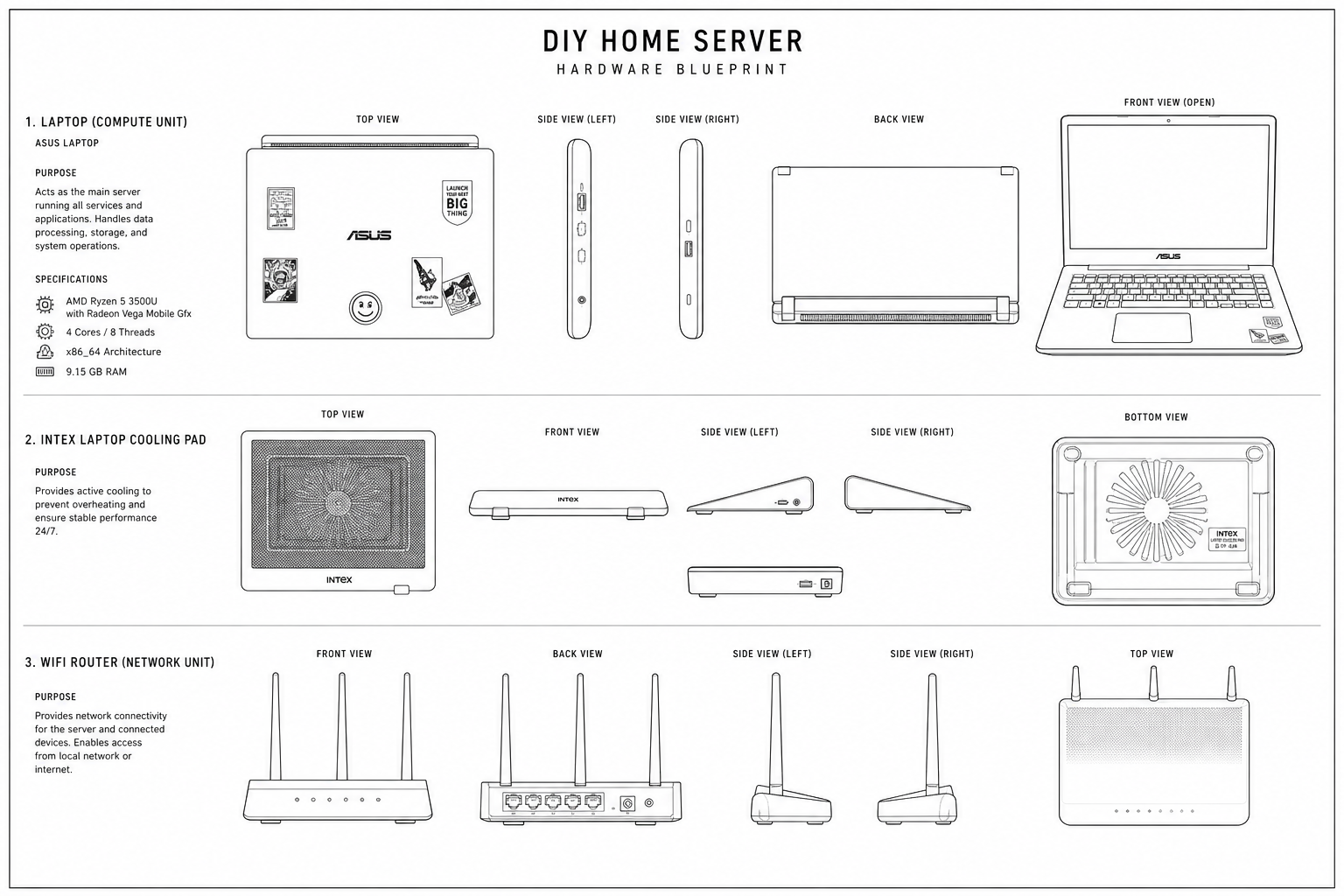
The current host is a real laptop-based setup with active cooling and home networking. It is deliberately documented because the early system should be legible before it is impressive.
core software
Docker gives deployments a repeatable boundary on the machine we control. Around it sit build detection, process supervision, routing, certificates, logs, and the glue that turns agent output into live URLs.
intelligence layer
State-of-the-art Anthropic and OpenAI models help read unfamiliar projects, infer build paths, and recover from deployment ambiguity. DSPy is the tuning loop that turns those decisions into a system we can improve.
support rails
Cloudflare and AWS services help with the parts that should not be romanticized: DNS, edge protection, storage, queues, and operational backup. They support the lab; they are not the whole story.
load
Traffic is handled as a set of visible pressure points: what gets cached, what gets queued, what stays on the host, and what moves out when a demo becomes real usage.